An Act Of Intimacy by Ruby Donohoe

BY RUBY DONOHOE
Performed September 2020
Photos by Jorge Serra ft Younghee Park & Ash Djokic

An Act of Intimacy
was a one-on-one participatory performance exploring the politics of encounter. In a time where we are so practiced in our solitude and so practiced at our distance, what does it mean to be intimate?

“In fact, intimacy relies on separation”

Covid undeniably dispels the myth of the sovereignty of the self - our interconnection is increasingly beyond doubt- and yet our survival also relies on our isolation. Our capacity for autonomy is suddenly vital to the collective in a way few of us have experienced in our lifetimes before now. Mirroring this paradox of simultaneous radical intimacy and radical alienation, An Act Of Intimacy was an invitation to reimagine the porous divide between connection and separation. 

As the artist, I chose the performance site.
Both participant and myself agreed upon a time.
And, for the work itself, participants proposed an act of intimacy for us to undertake together.

Participants were free to suggest any act- anything from holding one another to cutting one another’s hair to taking a nap to changing the bandage on a wound to sharing a cigarette out the window to whatever felt right for them.

SUP06294.jpg

“The work relies on my personhood not my commodification.”

Before we met, participants were given an audioscape meditating on the nature of intimacy in all its elusiveness and all its forms. This audioscape then led them to a space that was empty aside from two plastic head-to-toes suits. This is where we first met one another.

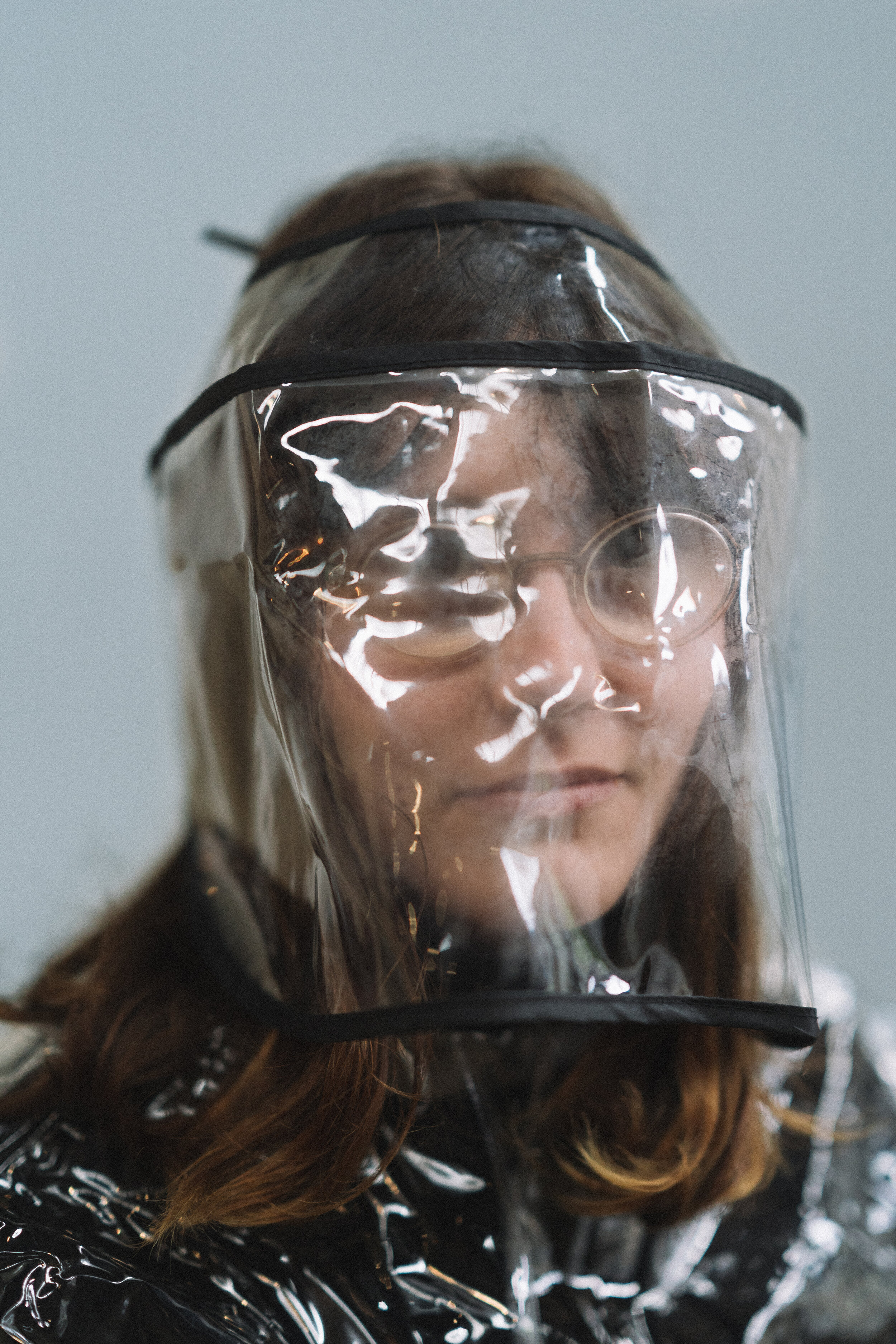
The intention behind the audioscape was to create an insular environment that invited sensitisation - to self, to environment, to body- as a way of supporting participants to fully arrive within the work. Creating this holding-zone moment of privacy felt essential. Establishing relationship with ‘self’ prior to introducing the idea of relationship with ‘other’ seemed like the only place to start. Both participant and myself wore head-to-toe transparent plastic suits. Covid made the suits a practical necessity but they came to signify another necessity. That, in fact, intimacy relies on separation. The suits created a stronger impulse and willingness towards meeting one another as they offered the safety of a stable point of division. This state of coexistence- as opposed to collapsing into one another or conversely a repulsion away- became transformative.
SUP07064.jpg

“…a complex, utopian act.”

At first, the suits were a little complicated to get on and move around in. They took some time to get used to. Just as we both took some time to get used to one another. They presented a very literal question of ‘How do I do this?’ that we each had to answer on our own. How do any of us navigate intimacy?

Moments of awkwardness that may arise - moments that require negotiation - became conducive to a de-masking process that often allowed trust to settle. The suits made us both very aware of our human surface. There was a small amount of body heat and static generated in the suit which increased awareness of the peripheral space around the body. This extra layer of sensorial information created a small shift in attention which supported enough estrangement for a simple human exchange to be visited anew, seen in a different light.

The participants and myself entered the space from different doors at the same time. The rationale was that this would counter the sense that they were entering my territory and, ideally, equalise the power dynamic between us. 

Creating a ‘neutral’ performance site seemed important so that I wasn’t pre-determining the tone of the encounters and so that the culture of the space could emerge mutually between us. The problematics, of course, lie in the impossibility of ‘neutrality’. An unresolved aspect of the work was the intention to create a space that felt as safe for one person as any other to explore intimacy. However, a duty of care is not ‘solved’ by the imaginary possibility of a clean, blank slate. My experience of the politics of space could not be separated from the process I was pursuing.

Minimalism is not neutrality- despite what our white, cis, hetero, art historians tell us.
Nonetheless, I did end up presenting the work in a large, industrial, empty warehouse.
No, I know. Uhuh. Yup. I’m aware. 

SUP07067.jpg

“I becomes a performance site.”

Of course, intimacy relies on the personal.
The work relies on my personhood and not my commodification.

And yet, the reality can’t be ignored that as an artist I am still bound by the realities of providing a cultural product- a transactional service engineered through a specialised skillset.

Emotional labour is still labour. Its politics and the historical precedents of who this work is done by and for whom can’t just be left at the door.
Making room for both ‘self’ and ‘artist’ to exist within this work became a complex, utopian act.

How, when inviting intimacy, do you navigate consent- especially in a constructed context like this?  How do you navigate any difference in ethics? Whilst still engaging with my contract to facilitate an art experience, what are my commitments if the proposed conditions for intimacy diverge from ones that I would otherwise disengage from in my personal life? How legitimate is it for a participant to purely want to push my limits as the artist? What does legitimacy have to do with anything? What are the edges of the work? Where are its boundaries? When is the work no longer the work? 

I still don’t have the answers to all those questions. 

The Suzuki Method of Actor Training by Ruby Donohoe

BY RUBY DONOHOE
2017, NYC

The greatest virtue of the Suzuki Method of Actor Training is it requires you to show-up. 
Completely.

Screen Shot 2021-01-31 at 11.05.52 am.png

“….the epiphanies along the way are really none of the performer’s business”

The training asks you to surrender yourself to this daily ritual and process - indefinitely. For me, this is the most transformational request of the training. It challenges you to set a non-negotiable in your life. The forms themselves do not negotiate- there are no concessions made within the training. The form is either achieved or it is not (and let’s be honest, it’s never ‘achieved’) - but the ongoing practice of the forms also demands a resolute, upright commitment. Can you give yourself to a devotional practice day after day? I’m tempted to talk a lot of hyperbole about the lessons of the training forms and the performance values they instil and how these revelations inspire longevity with the training. However, my great feeling is that the epiphanies along the way are really none of the performer’s business. Yes, they are crucial to the training- to have concrete, articulated embodied goals both long-term and from moment-to-moment. In fact without these goals, you just drown in the training.

However, a commitment to the practice cannot be innately tied to the elating, penny-drop moments. Because there are a great many moments where epiphanies don’t come. So many. The training sets impossible goals and you go after them as if they are possible. This training is an engagement with the ideal, a pursuit. And then, of course, it wrestles with it in the finite, messy, and inadequate terms of the body and mind.

At these times, the practice demands you have a faith in something larger than the tyranny of convenience, larger than the trappings of productivity and allure of self-growth or self-improvement. You have to have a reason to do Suzuki and these reasons must be your own. The training offers a framework for you to discover your reasons, renew them or abandon them but it certainly doesn’t prescribe them. It is essential for the artist to practice this autonomy of thought, accountability, and to struggle with meaning - especially in the terrifying proposal that we now live in a post-truth era and at a time where our desire as a race to self-destruct is now clearly manifesting in the rapid destruction of the entire planet. And so, the artist must ask themselves and one another again and again: What do we need? What do I work for? What am I giving my body to? For whom? And how? What do I stand for? Whatever your answers, the Suzuki training ultimately demands a faith in a value system that is passed on from live body to live body. The Suzuki Method only exists in this way- not in books, or in videos, or in lectures.

3C squat arty edit .jpg

"...the imperfect, striving, alive, and unholy body that shows up in the thick of crisis with dignity."

 It is a time-based practice. Inevitably revelations will emerge, they are forgotten, they are remembered again and they develop in layers, sometimes imperceptibly so. In the meantime, you attend to something else beyond you via the only implement you have- ‘you’. The Suzuki Method is at its core a practice for the spirit- a reminder that performance is an act of the spirit, that the wellbeing of the actor’s spirit is entirely crucial to the craft and that this essence is not some fixed entity but in constant change. Not the moralised spirit either – a vehicle for ethics - but the imperfect, striving, alive and unholy body that shows up in the thick of crisis with dignity. The dignity that arises from ongoing transformations born from a deep practice with the impossible and the realisation that the natural language of the body is one of co-existing paradoxes and that, in fact, it is only the rationalising mind that struggles with conceiving these inextricable opposing forces. The dignity I mean is not necessarily beauty or virtue (it can be both as a by-product) but I think the dignity you sense in performers who have trained in Suzuki for a long time is equal measures of deep investment and non-attachment. 

3B+foot+up+close.jpg

“It cultivates an ability to live in the mess.”

All of this to say, the Suzuki training forms remind the actor that the spirit is not some elusive, airy state but that it is accessed somewhere between the bone, muscle, gristle, nerves and the trying. Between earth, the sky and where you stand. The Suzuki Method does not deal with the metaphorical body or your idea of the body or give you any leeway in terms of the reality of it. It tells you precisely its capabilities and its weaknesses. It tells you in real time. This training re-wires your mental capabilities by asking your intelligence and your emotive, ego life to attend to the body and its capacities for expression- its ability to concentrate and how adept it is at task-completion without over congratulating or berating itself. It teaches the performer how to acknowledge the body’s feedback in a way that better optimises their ability to show-up in the next moment. It cultivates an ability to live in the mess. To relish and show-up for the problem. To stay awake in the middle of it- a feat desperately important to endeavour towards now more than ever.

My strong feeling is that theatre is violent- in its sacrifice and its immense pleasure. I am yet to decide whether I can devote myself to living so violently. In the meantime, onwards. I know no other alternative. But there is a deep brutality involved in the act of being burningly present for hours of training, performances and residually how the artist inevitably takes these lessons into their daily lives.

Tabi group edit.jpg

“My strong feeling is that theatre is violent- in its sacrifice and its immense pleasure.

I am yet to decide whether I can devote myself to living so violently.”

The violence is essential to the theatrical form- it is the reality of the living body. Throbbing, breathing, moving, reducing, expanding flesh. The cost of living is that to continue living there must be the death of something in return. Nourishment requires the end of some aspect of life for your continued life. There are times for me, often, when I think in theatre the brutality of the moment is not worth it. Its beauty is not so moving as other art forms. Its humanity too distant. But its pursuit is radiant. At its worst, the grasping of theatre is sickening. It reflects too much my own. At its best it’s the whole story of living.
So you hedge your bets and try to make manifest the latter.

And so, one of the Suzuki Method’s necessities is that it acclimatises the performer to the brutality of experiencing in a living body as well as the dissonance between process and product. It makes you dwell in that space of vivid experiential sensorial awareness. For a long time. It tells you to attend one thing at a time and everything all at once. It allows you- not all the time but some of the time- to be relieved of the desire for gratification. And so, you find yourself shockingly thrust into the present. In that way, in the relationship with the impossible and infinite/finite goals, it frees you. It diminishes delusions or at the very least threatens them. The ones you have about who you are, your capabilities and what you stand for and what you can withstand. It encourages you to dwell in that space between who you are, actually, and what you would like to be. Rather than bring those two realities closer together, it endlessly pushes them further apart, reminding you how important it is to activate the space between the way things are and how you want them to be.


FIND OUT MORE ABOUT
Suzuki Method of Actor Training
www.scot-suzukicompany.com/en/

SITI Company
www.siti.org

Ruby Donohoe studied the Suzuki Method of Actor Training as part of SITI Company’s 2016/17 Conservatory and their 2016 Winter Intensive (NYC). She has also trained in the methodology with Zen Zen Zo Physical Theatre since 2010 and as part of the company’s 2014 Performer Internship (Australia).

Photos: Dexter Ciprian (2017) ft Andrea Ang, Caitlin Lavery , CJ Healy, and Ruby Donohoe
First Photo: Suzuki Tadashi (Taken from the SCOT website.)